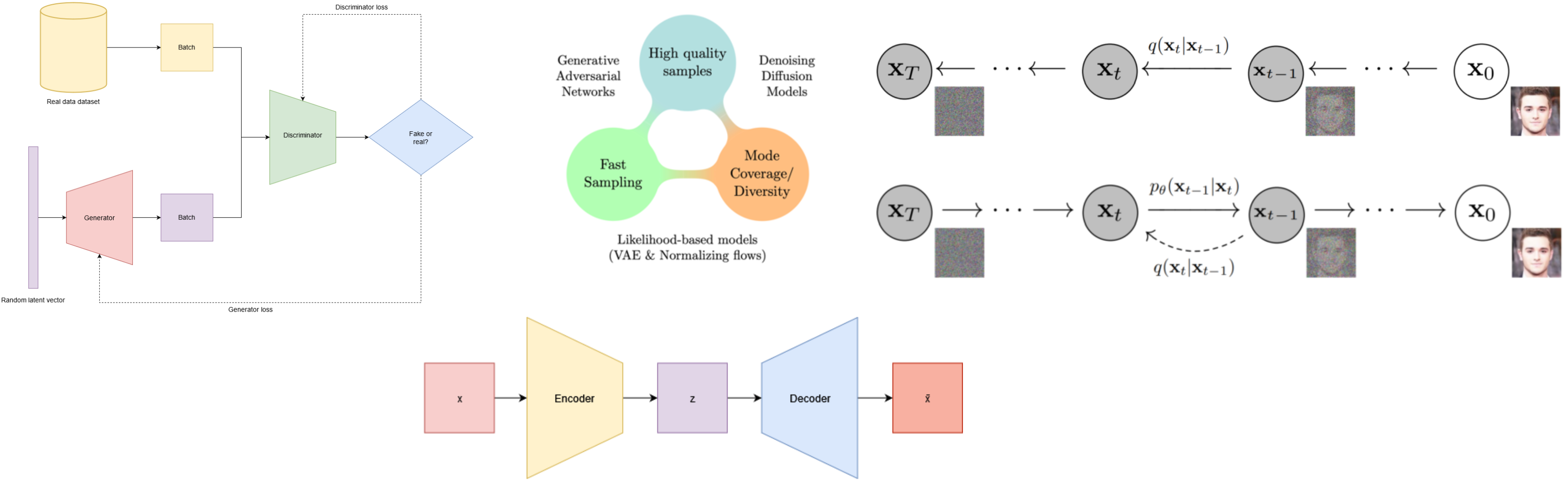
The Generative Trilemma: A quick overview

Generative models are a class of machine learning that learn a representation of the data trained on and they model the data itself. Ideally, generative models should satisfy the following key requirements in a real environment: High quality samples refers to those samples that captures the underlying patterns and structures present in the data making them indistinguishable from human observers. Fast Sampling is about the efficiency of image generation and the computational overhead that can cause generative models. Mode Coverage/Diversity points out how the model is able to generate a full range of mods and diverse patterns present in the training data Fig. 1. The Generative Learning Trilemma ...

Date: July 10, 2025 · Estimated Reading Time: 15 min · Author: Oriol Alàs Cercós

Reconeixement de Vehicles i Reconstrucció de Trànsit amb NebulOus

Overview Presentation on vehicle recognition and traffic reconstruction using the NebulOus cloud platform. The talk covers the application of computer vision techniques for traffic analysis and the deployment of ML models in cloud infrastructure. Key Topics Vehicle detection and tracking Traffic pattern reconstruction NebulOus cloud platform architecture Real-time processing challenges Event TechMeeting is a technical meetup in Lleida focused on emerging technologies and their practical applications.

Date: May 1, 2025 · Estimated Reading Time: 1 min · Author: Oriol Alàs Cercós

Thresholding, filtering and morphological operations

Traditional computer vision techniques involve methods and algorithms that do not rely on deep learning or neural networks. Instead, these approaches are not data-driven and they use classical approaches to process and analyze images. So, in this post, we’ll explore three thresholding techniques! Thresholding When the task is to distinguish the background from the foreground, thresholding provides a straightforward solution. We will use this image as an example. ...

Date: October 25, 2024 · Estimated Reading Time: 3 min · Author: Oriol Alàs Cercós